Newborn Calf Problems: Giving Animal CPR to Calves
Giving CPR to Newborn Calves.
Reading Time: 7 minutes
Be prepared for emergencies during calving season by learning animal CPR. This skill can help save more newborn calves and improve your herd’s survival rates.
by Heather Smith Thomas
Giving artificial respiration to a newborn calf may save its life if it isn’t breathing after a difficult birth. In the past 55 years, my husband and I have saved several calves that would’ve died otherwise. Several were calves that were breech and wouldn’t start to breathe. Some were limp and unconscious, after a long and difficult birth.
The most spectacular save I can recall was a big bull calf we pulled from a heifer about 50 years ago. We knew the calf was alive when we started (his legs jerked when we attached the pulling chains, and his tongue wiggled while his head was coming out), but when we finally got him born, he seemed dead. This was before we had a mechanical calf puller, so we had to use the strength of the two of us pulling by hand — and it took a while.
The calf was limp and blue, with no reflexes, after we finally got him out. When I checked him, I felt a heartbeat and immediately began artificial respiration. My husband massaged the calf to help increase circulation and periodically checked the heartbeat as I blew air gently into the calf’s lungs — with my mouth over one nostril and holding the other one closed.
After 30 minutes, the calf began to lose his blue color and started to breathe on his own. After another 15 minutes, he regained consciousness and was able to hold up his head and look around. We fed him colostrum via stomach tube, since he wasn’t strong enough to nurse a bottle. It took a few hours for his tongue and nose to return to normal; they were swollen from the pressure of being in the birth canal too long. But he soon recovered. Since that time, we’ve tried to select for smaller, easier-born, fast-growing calves (using bulls that sire calves with low birthweight, especially for use on heifers), and have reduced the number of hard births. But there are still times a calf may need help to start breathing.
Managing Newborn Calf Problems
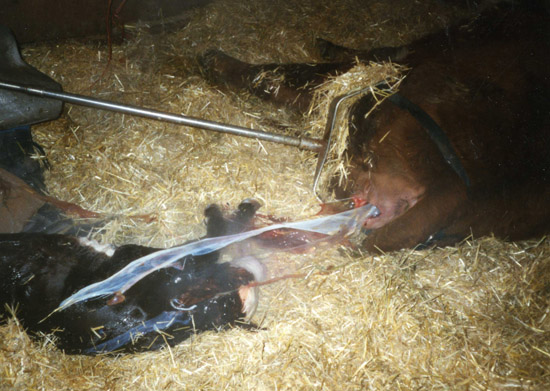
Some calves are still encased in the amniotic sac after sliding out of the birth canal — which can happen with a fast, easy birth. Sometimes the sac just doesn’t break. Unless the calf struggles and breaks the membrane, or the cow jumps right up and starts to lick the calf’s head, the sac may remain intact. Some membranes are thin and easily broken, while others are thick and hard to break.
If you’re present at the birth and the sac doesn’t come off the calf’s head, break the membrane and wipe the fluid away from the calf’s nose and mouth so it can breathe. Most calves don’t try to breathe until the fluids are away from the nose. Instinctively they hold off, to keep from drowning, but this means some calves won’t start breathing soon enough; the sac remains over the nose, and they suffocate.
In other cases, the calf just needs help to start breathing, especially after a long or difficult birth or a breech birth; they may be exhausted or unconscious. Most of the time, these calves are normal in all other aspects; if you can get them to breathe, they’re fine.
Checking Oxygen Levels
Check the heart rate (normal for a newborn calf is about 100 to 120 beats per minute) to determine whether a calf is in respiratory distress. The heart rate drops as body tissues are depleted of oxygen. If a calf fails to start breathing within 30 seconds after the birth and has a heart rate lower than normal, they’re in trouble.
To check a heartbeat, put your hand on the lower left side of the ribcage, behind and above the elbow. A young calf’s heartbeat is easy to feel; it’s beating strongly and there’s very little tissue between it and the outside chest wall. If the heart rate has dropped as low as 30 to 40 beats per minute, the calf’s condition is critical.
Another way to tell whether a calf is short of oxygen is the color of his mucous membranes. The normal newborn calf’s gums will be pink. If the gums and nose are grey, colorless, or blue, they need to start breathing immediately.
Often, you can get a calf to start breathing by tickling the inside of one nostril with a clean piece of hay or straw. This makes them cough or sneeze and begin to breathe. If they’re unconscious, however, tickling won’t work; they need artificial respiration.
Performing Animal CPR on an Unresponsive Calf
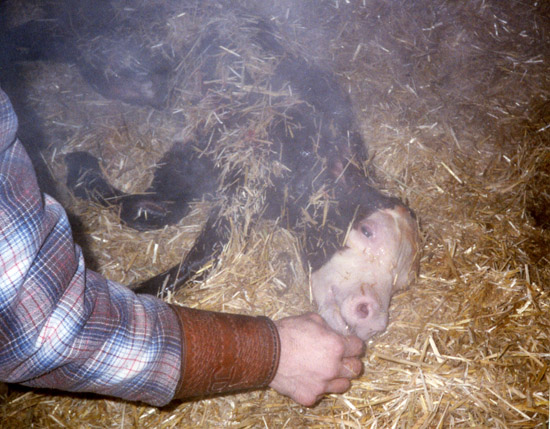
First, check the calf’s airway. Roll them up onto their breastbone in an upright position, with head and chin resting on the ground and their nose as low as possible. This will allow fluid to drain out of the nose. If the airway is still full of fluid, use your finger to strip it from the nose and mouth in a suction action — a bit like squeezing a tube of toothpaste. A rubber suction bulb to clear the nostrils works best; it’s an essential supply to have available during calving season.
In a normal birth, the calf’s head emerges between the front legs, and, as the ribcage comes through the birth canal, the pressure of the cow’s pelvis squeezes most of the fluid from the calf’s airway. When the ribcage expands again after it passes through the birth canal, air is drawn into the lungs and starts them breathing. If their airway is full of fluid, however, that first breath may draw some of the fluid down the windpipe and the calf may have rattly breathing and cough a bit. If they’re weak and don’t immediately start to breathe, this fluid will also make it harder for them to begin to breathe properly. The suction bulb can help remove it.
In a breech presentation, the calf’s head is still inside the cow and amniotic fluid is more likely to remain in their airway. In some cases, the umbilical cord is pinched off or broken, as the hindquarters pass through the cow’s pelvis, so the calf needs to start breathing immediately. In this emergency, the calf must be pulled out swiftly and started breathing as soon as possible. Years ago, veterinarians recommended holding the calf up briefly by the hind legs, with head hanging down, so fluid could drain from the airways. This is no longer suggested because it puts more pressure on the calf’s lungs and can damage internal organs. It’s better to just try to tickle their nose and get them to cough.
Brisk massage of body and legs helps increase their circulation and stimulate their breathing reflex. Flexing the legs also prompts some lung action. If they still haven’t taken a breath after two minutes, you’ll need to blow air into their lungs.
To resuscitate the calf, lie them on their side, with their head and neck extended. Cover one nostril tightly with your hand, and hold the mouth shut. Gently blow into the other nostril. Don’t blow rapidly or forcefully or you may rupture a lung.
It helps if two people work as a team. One person can rub and massage the calf and gently work its legs for stimulation, while the other holds the calf’s head and blows into the nostril. Blow until you see the chest move and rise, then let the air come back out on its own. Then blow in another breath until the chest rises again to show that the lungs are filling. Continue to fill the lungs and let them empty, until the calf starts to breathe on its own. It may take just a few breaths, or it may take a while, depending on the calf’s condition.
Usually, once the tissues become less oxygen-starved, the calf’s heart rate will increase, and they’ll regain consciousness and start to breathe. Their breathing may be erratic at first, but if everything else is normal, they’ll soon develop a regular breathing pattern.
Artificial respiration can save calves that would otherwise die following birth complications or a breech birth. If there’s a heartbeat, the calf is still alive, and there’s hope. With a little effort on your part, you can give such a calf a second chance.
Starting the Heart
If the calf has no heartbeat after a difficult birth but hasn’t gone too long without oxygen, you may be able to revive it. Veterinarians will tell you that it’s almost impossible to start the heart again, but about 15 years ago, our son and his wife pulled a big bull calf they knew had been alive when they started pulling (the feet jerked when they attached the chains). By the time the calf was delivered, it was limp, with eyes glazed, and no heartbeat — technically dead.
Frustrated and desperate, because he knew the calf was alive just moments earlier, our son slammed his fist onto its ribcage, directly over the heart, and it started to beat again. His wife immediately began to blow into the calf’s nostril, and our son rhythmically pushed on the ribcage to stimulate the heart, which soon began to beat strongly on its own. After about 20 minutes of artificial respiration, the calf regained consciousness. That calf took about 12 hours to recover enough to nurse its mother — it was fed colostrum by tube in the interim — but the recovery was complete, with no ill effects from being brought back to life.
More Resources for Calf Care
- Dealing with Diphtheria in Calves
- Safely Castrating Calves
- How to Treat Colicky Calf Bloat
- Preventing and Treating Cattle Scours in Calves
Heather Smith Thomas ranches with her husband near Salmon, Idaho, raising cattle and a few horses. She has a B.A. in English and history. She has raised and trained horses for 50 years and has been writing freelance articles and books nearly that long, publishing 20 books and more than 9,000 articles for horse and livestock publications. Find Heather online at HeatherSmithThomas.BlogSpot.com.
Originally published in the July/August 2025 issue of Countryside and Small Stock Journal and regularly vetted for accuracy.