Raising Domestic Yaks

Reading Time: 4 minutes
When you first pull into Wooly & Grunts, be careful where you park. The spot on the end may look perfect, but you may find as you back in that it’s already occupied. This sunny spot on the tar happens to be a favorite snoozing spot for Oreo, the Porch Yak.
At 18 months, Oreo is just a baby, but 300 pounds of baby yak looking for attention can be pretty overwhelming at first introduction! Oreo is more like a dog than livestock, and a “puppy” this big can be quite a handful. His “mom,” Adria, came to the rescue, though, and with a few scratches and pats, Oreo and I were fast friends. Once we met, he was happy to stand around and ”nurse“ on Adria’s fingers for a few minutes and then follow us docilely as we toured the farm.
Domestic yaks are bovine, closely related to cattle, and traditionally found in the Himalayas, Tibet, Siberia, and Mongolia. Finding them in central Maine was a surprise that quickly made sense. Yaks take up about a quarter of the space needed for a beef or dairy cow, with about four yaks per acre. Even some large breeds of sheep take more pasture! The yaks’ long, heavy coats make them extremely tolerant to even the worst Maine winters, and they can provide a small farm with milk, fiber, meat, and built-in landscaping talents.
The Porch Yak is a Royal yak (of course!), meaning he is white with brown/black spotting. Lokie and Adria told me yaks come in far more colors than I would have guessed. Most of their herd is black, but yaks can also be found in black with white trim, golden (or blond), and white.
Oreo isn’t the only yak living on the farm’s 91 acres. Adria and Lokie Horn own about 36 yaks, as well as their sheep and chickens. They use rescued Kangal dogs for livestock guardians, and — once their owners cleared me — these impressive canines spent much of my visit snoozing in the sun or watching the fence borders. The yaks eye them warily if they get too close, but in general, they seem to respect each other’s space.
Very few of the yaks came close to us. They were far more concerned with grazing the last of the fall pasture off in the distance. The yaks eat almost exclusively pasture and hay, with grain used only for socialization with their humans. With winter coming, they will be moving to a hay diet soon, but even here, the expense is less than one would expect from such large animals. Lokie told me that it takes his full herd about three weeks to finish off a 4×4 bale of hay, meaning that the yak eats less — and cost less — than his sheep do.

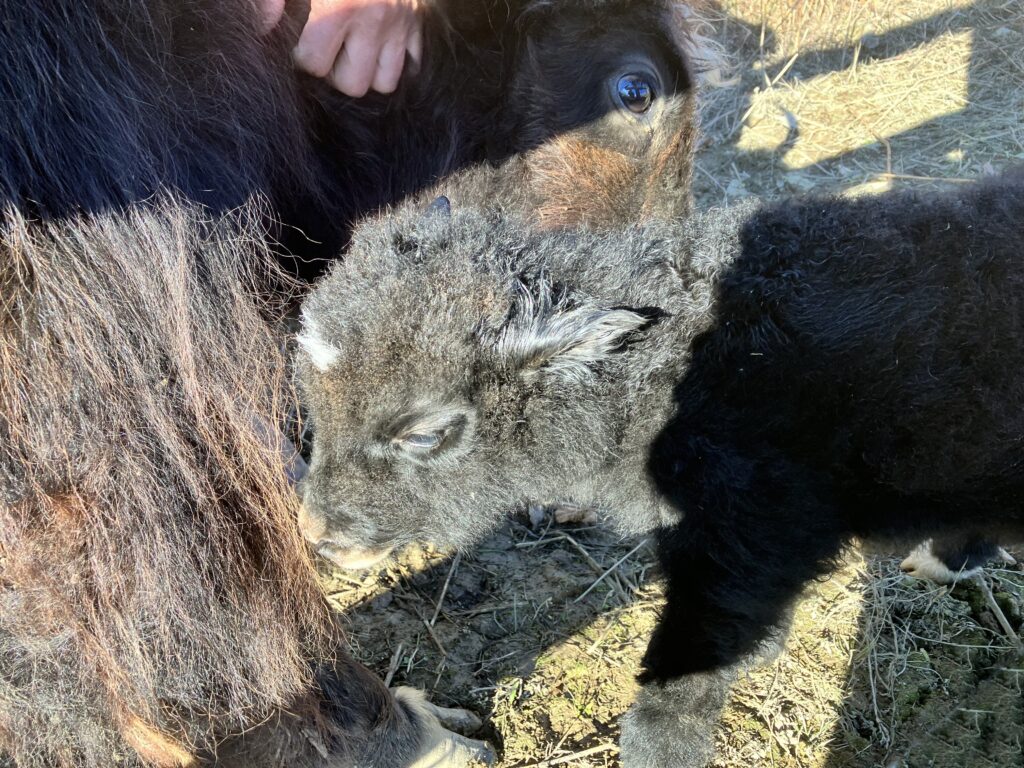
One female, named Pocahontas, gave birth only shortly before my arrival. Yak will birth year-round, and a fall birthing isn’t unusual. She had been separated from the herd, along with her calf, and would remain in her own area for about four days to make certain everything was going well with the new baby. Both Pocahontas and her calf are black yaks, and it was fascinating to watch how the newborn blended in with his mother’s long coat. While nursing, it almost disappeared underneath her, and her attentiveness to the afterbirth clean-up would be the only clue for predators that the tiny form was even there.
Yaks give birth easily, with little intervention, and make excellent mothers. Lokie told me bottle babies are rare for them. The young are about 10 to 15 pounds at birth. At Wooly & Grunts, once the separation period is up, the mothers and young are returned to the herd. Females are cared for by the herd — and their guardian dogs — as they grow and develop. Males remain until they are weaned, and then they are removed to a “boy pen” with other yaks of similar age. While yaks don’t generally breed until about five years old, it’s better to be safe than sorry!
That five-year breeding age is one of the reasons yaks are not more common in the United States. With a food system driven by fast growth and production, yaks are simply too slow-growing for the industrial machine that produces most of our meat and milk. With the current common breeds, a beef cow will often be butchered between 1 to 2 years at a weight of about 1,400 pounds.
Yaks, on average, will not hit full growth, mate, provide milk, or be butchered until about five years old — more than twice as long as domestic cattle. Female yaks will reach 700 pounds when fully grown, while males reach about 1,500 pounds. At two-years-old — the earliest one might butcher a yak — a bull will be about 500 to 700 pounds. To an industrialized system like ours, the yak can seem like an inefficient meat source.
Milk production is also much lower, and a high-yielding yak will produce only about 400 liters a year. Like the yak itself, though, the milk is good for multiple uses. Yak milk has a fat content of about 6% and is mainly used for butter or — in traditional cultures — “milk tea.” Yak milk is also the only milk used for Chhurpi, a hard cheese with a shelf life of literally years.
Despite these lower production levels, yaks remain a fascinating choice for the small farm that wants to do something a little different and is interested in dual-purpose production. The meat is leaner than bison and high in protein and B vitamins, and it is advertised as being richer and slightly sweeter than beef.
Yak fiber — or yak wool — has been used for over 1,000 years in Himalayan cultures and is popular for clothing and camping gear. Even the outer, coarse hairs are useable for rougher fabrics, and the soft, downy undercoat is comparable to cashmere. All of this is from a single animal with smaller space and food requirements than most cattle breeds and some sheep breeds!
Just be careful where you park.
Do you raise domestic yaks? We’d love to hear from you in the comments below.
Originally published in the July/August 2023 issue of Countryside and regularly vetted for accuracy.