Apple Orchard Leads To Organic Business
Reading Time: 9 minutes
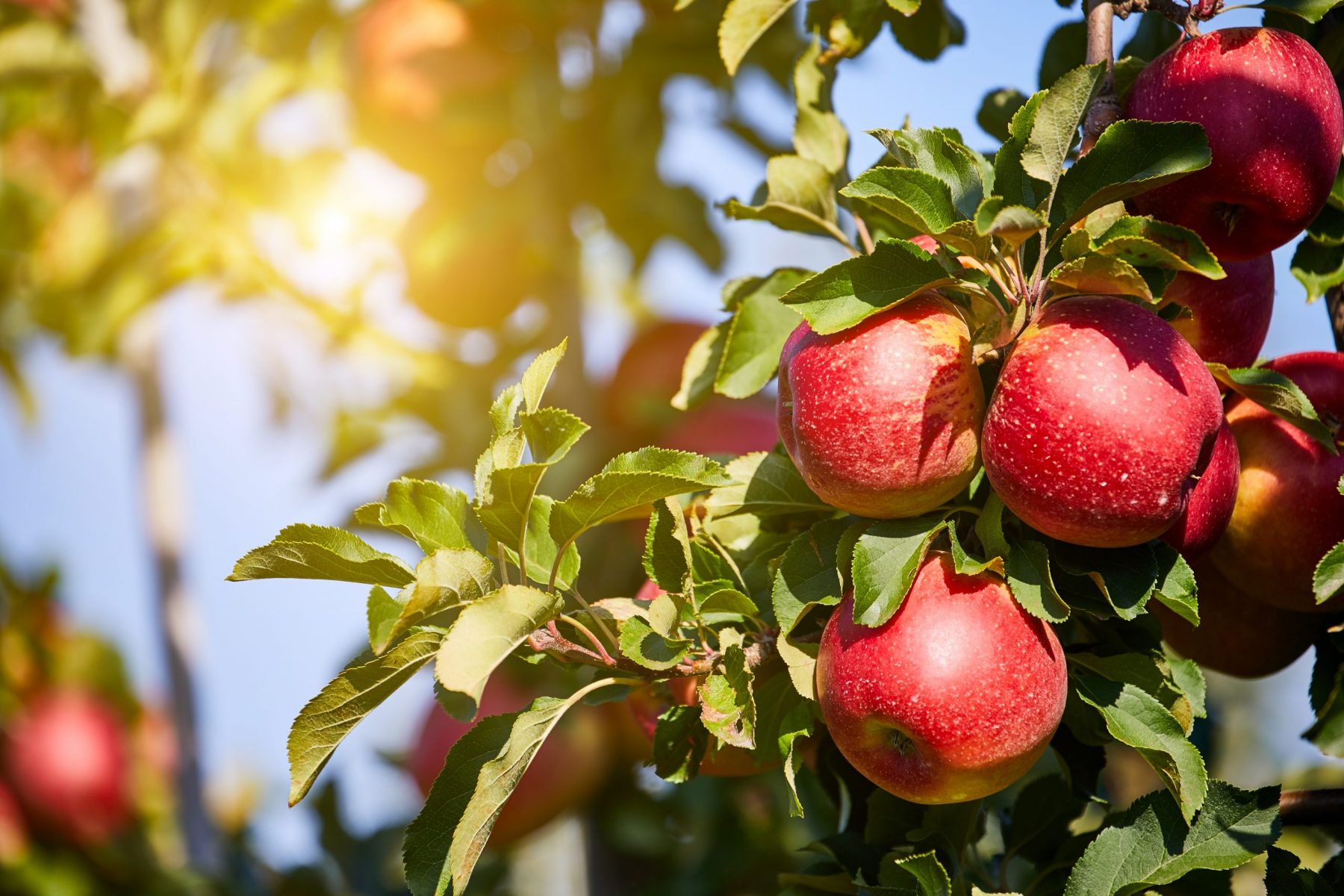
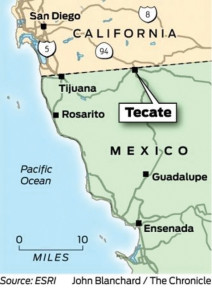
By Kevin Geer – I started this project when I moved to Northern Baja, California, where I live on a small 15-acre ranch. My ranch is located in a gated community of like-sized lots, most of which are weekend retreats for people escaping from San Diego or Tijuana. I’m located just a few miles from the international border with California, about half an hour east of the sleepy little town of Tecate. The elevation is just under 3,000 feet, allowing for real seasons with some snow in the winter.
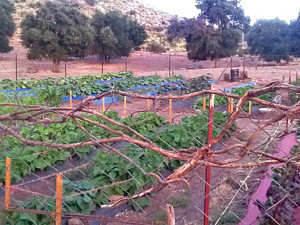
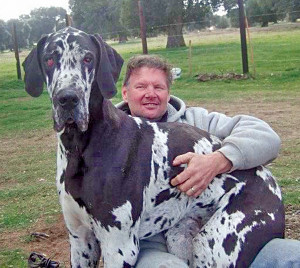
The land comprises rolling hills and valleys dotted with live oak, Manzanita, and sage. Water is drawn from each ranch’s own well, with varying degrees of success. Mine is “hand-dug” and about 35 feet deep. It allows me to irrigate one to two acres of vegetables with enough water left over for the animals (20 Watusi cattle, eight horses, two Great Danes, and several working cats and chickens) and two houses. With the garden getting the lion’s share of the available water, I conserve as best I can by mulching heavily with oak leaf litter and livestock manure. The garden is planted in standard rows using a basic drip line system. Last year, I added colored plastic row covers in an attempt to extend the water usage even more. The idea behind the “colors” being that they can add up to 20% more to the harvest of veggies like tomatoes (red plastic), and melons and cucumbers (blue plastic).
I used the regular black plastic as well and didn’t notice much difference in yields between the various colors, but admittedly, it wasn’t set up in an organized way to test the idea. One thing that was apparent was the weed growth. The lighter the color, the more weeds. The problem is that after the season is over, you have a lot of plastic that can’t be used again and must be disposed of… It did save water, about 20-30% less water usage than an uncovered row. In the West, it’s all about the water.
Where Are My Apples?
When I first moved in and started working on the garden plot, a neighbor noticed my interest and commitment to growing some veggies; most ranches here graze livestock on their property. So he stopped one day and asked if I could visit his place sometime and look at his two acres of apple trees. He planted 900-plus trees five years ago and had yet to harvest a single apple! I mentioned that I knew very little about apples but would be happy to take a look.
The next week, I stopped by, and as his worker walked me through the orchard, explaining how they “got to where they were,” a few things were immediately obvious. The trees had never been pruned! The dripline system looked like one of those kits they sell to people who don’t garden, and there was a general lack of knowledge about fruit groves and their care.
When I asked the worker why he thought they hadn’t harvested any apples yet, he answered he was sure it was because when they planted the trees, it was the wrong time of year. I remember thinking at the time, well, the good part was that I did have some knowledge that could help immediately, the worst part being these guys needed a lot of help that I wasn’t qualified to provide. So, the next thing to do was go online and research apple tree cultivation basics.
Back to School
While doing this research, I came across several colleges that offered fruit grove management courses that offered certificates upon graduation. Knowing this, I met with my neighbor and proposed the following: if he’d be willing to pay for half the tuition fees, I’d cover the other half and, upon completion of my studies, would apply my knowledge to his orchard, working as a consultant, and take a percentage of the harvest profits for the first three years. And so began our collaboration.
Looking back now, I see there were many difficult moments as well as levity and fun. There were serious financial decisions like tearing out more than a quarter of the trees to replace them with a more appropriate variety for our climate. I received some good advice and a lot of help from C&O Nurseries in Washington State, but that actually bore fruit.
My funniest memory was the time we went through the orchard for the first pruning. With pruning shears in hand and my neighbor right behind me, each tree trunk was cut from a bushy four to five feet to a pitiful-looking stump of about 18 inches. With every cut, I would hear a groan followed by a sigh. This went on for the first 20 or so trees until I finally suggested that it would be better for all concerned if he went inside and waited until I finished before coming back out!
After getting the right trees planted and everything appropriately pruned, with a proper drip line system, we were ready to start good basic orchard care, waiting for our first flowering. We settled on four varieties that flower late in the season because we tend to get night freezes late in the year (one year, we had a night freeze during the first week of June!), so Golden Delicious, Roma, Braeburn, and Red Chief give us a good variety and late season blooming.
We’re in Business!
Our flowers started opening the last week of March and continued through the end of April. On those late freeze nights, we put out our own, modified version of smudge pots that slowly burn sawdust to protect against damage from the cold. This has worked well for us, and we have come through the flowering period with very little frost damage.
Varmint Control
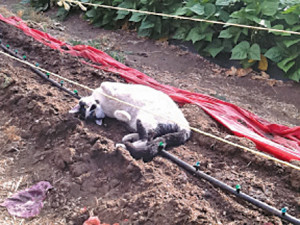
Now we’re into the growing season. Since there are no other growers in or around our valley, we have no infestation problems from the neighbors’ plots and no coddling moths. Our major predation problem is varmints — gophers, small birds, squirrels, and rabbits (in that order). The gophers can be a real nightmare. The amount of damage they can do in one night is incredible. When I researched gopher control on the Web, I found some good (and expensive) options for a tractor attachment with poison baiting. The price was unrealistic and not organic, so we needed new options. I did notice that there was no gopher, squirrel or rabbit damage in the garden with the cats on my ranch. None. So I suggested working cats for our varmint problem in the orchard.
We find that a minimum of two cats per acre are needed to keep the orchard basically free of gophers, which tend to appear early every spring. The cats clear the orchard nightly and have become a good and inexpensive way to manage our varmint problem.
Shooing the Birds Away
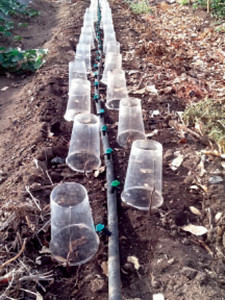
Now for the birds. They’re bold and manage to flit away from the cats just before being caught. The most frustrating bird damage comes when the seedlings are just sprouting. The birds hop by, cut the sprouts just above ground level and leave the dead seedling there. I started using plastic cups and metal “stays” (from the dripline) for seedling protection (it keeps ants off too). Once the seedling has one or two sets of leaves, I can remove the cup and the plant is big enough to be bird-proof.
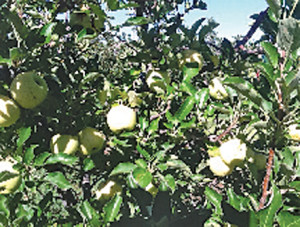
So now we’ve made it to the small fruit stage. We thin the fruit by hand and have a small amount of weeding to keep the orchard passable. We use a weed whacker to keep the weeds and green manure down. We plant a dry climate clover mix as a cover/green manure crop. The crop was ready for the first pick sometime during the last week of August. Our first year came in at just under one ton! Success, sort of…. So, what do we do with one ton of apples? Actually, we were able to sell some of the harvest at small local markets. Unfortunately, the price was the same as the stores were paying for their commercial fruit. In Mexico, it’s extremely difficult to find a market for high-quality organic produce.
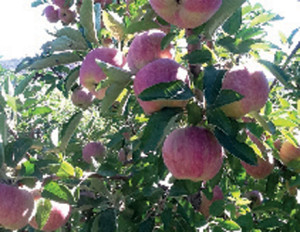
Serendipitously, my best friend Mike was working at a local spa named Rancho la Puerta (RLP) at this time. He led nature walks for RLP guests, where they learned about local edible and medicinal plants and herbs. When I mentioned our apples, he put me in contact with RLP’s Guest Services Manager, Martin Cortizo. Martin had been looking for a local apple supplier for some time, so our first meeting began a great, ongoing client/supplier relationship. We immediately started supplying apples on a weekly basis.
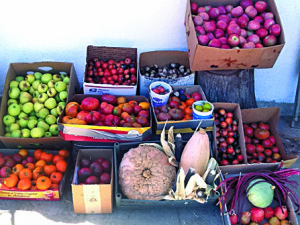
Now, RLP has its own gardens on site for its fruit and vegetable needs, which are called Tres Estrellas (Three Stars). They grow most of their produce needs, but not all of them. They use a variety of organic farming techniques as well, with the goal of creating a sustainable system. Water limits keep Tres Estrellas production levels lower than RLP needs. So, during the weekly deliveries of apples, I had a chance to speak with the chefs about their vegetable needs, brought in some samples and started including vegetables in the weekly deliveries. One of the things I like most about working with RLP is having access to the chefs. Every week, they’re excited to see the produce and discuss what I’ll pick for the next delivery. At the end of the season, Martin organized a meeting involving himself, the chefs, my partner, and me. I brought my favorite seed catalogs to review with the chefs and plan for the next year’s crop. Martin gave us a tour of RLP and a little information on their history and mission statement.
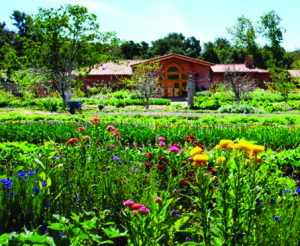
RLP was founded in 1940 by the Szekely family and is considered one of the founders of the modern fitness revolution. Their purpose is to “renew your mind, body and spirit. Retreat from life’s stress and distractions on a healthy vacation that empowers your true self. The Ranch encourages integrative wellness for women and men of all ages and fitness levels through exciting, energetic fitness options, delicious organic cuisine, and pure fun and relaxation.… All in a tranquil setting in the shadow of Baja California’s mystical Mt. Kuchumaa.” Travel & Leisure magazine has named RLP as the World’s Best Destination Spa for two years in a row.
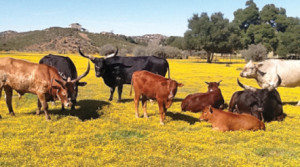
Some of the Watusi cattle and boxes of produce are served at the spa.
Much has changed with the food served at RLP since its founding in 1940. And yet, in many ways, little has changed, as Deborah Szekely will tell you. “Food has been a driving force in my life. My mom was V.P. of the New York Vegetarian Society in 1926 when I was four. Lack of fresh fruit and vegetables during the able life in Brooklyn to a grass hut in Tahiti.
My youth was a road map on which my parents and other health seekers were always looking for the perfect climate with the abundance of glorious fresh fruits and vegetables.” When the first guests arrived at RLP, Deborah recalls, “I did everything. The only items we bought from the store were sacks of potatoes, rice, onions, and beans. Everything else we grew. We learned together, my guests and I. It was learning ‘from the bottom up—the hard way,’ but the most effective way. Three times a day, our guests sat down on benches on long wooden tables under two arching oak trees and asked, ‘What’s to eat?’ I realized that our food, because of it’s simplicity, was becoming part of who I was. Fridays were especially fun. I asked guests to share their favorite recipes, then we’d put our heads together and try to ‘de-calorize them.’
“From the beginning, we experimented and tried every health discipline and diet theory that you still hear about today: bean sprouts and acidophilous milk, total fasting, interval fasting, the mucus-free diet, and morning walks…. Today, every ‘new’ diet plan is deja vu to me. The most satisfying shift has been so many cooks return to finding and treasuring sources for local foods.”*
That chat with Deborah Szekely gives a pretty good idea of what RLP is all about. I share their love for local, fresh, organically grown fruits and vegetables. I look forward to finding new and different varieties to plant in next year’s garden. The catalogs are just starting to arrive now, and I’m anxious to start planning.
*Resourced from a blog post by Katherine B. “Origins Of The Ranch, Part XIX” August 2, 2014