How to Mulch Around Trees
Reading Time: 4 minutes
Enhance your yard’s landscape and discover how to mulch around trees. Mulching around big trees is a simple way to rejuvenate and improve the existing soil.
by Mark Hall
Long ago, my wife and I started our life together in a small ranch house in the big city. It was a cozy little place fronted squarely in the cool shadow of a large oak. Our street was lined with grand old trees, providing a bounty of shade and a sense of protection from the grim concrete landscape beyond. Despite the sheltering nature of our neighborhood, there was constant noise from the nearby interstate to contend with, and we longed to return to our calm country roots. Finally, we set off on a course to make that happen.
We’ve never been the kind of people who crave attention in any way, but we really wanted to sell the house. As the time to put it on the market drew near, we needed to begin turning heads, luring potential buyers up the 100-foot-long driveway to get a closer look. Some top-notch landscaping can do just that, so naturally, we decided to make it a priority.
With a handful of tulips and a few dying shrubs, our current landscaping was severely limited and far from pleasant. It was time to gut the old and start over again.
One day, while planning a new display that would be bigger and better, I began to consider incorporating the nearby oak tree. As I knelt by it, contemplating, I couldn’t help but notice the poor soil condition around its trunk. Many patches were barren, and there were several exposed roots, which was a sure sign of soil erosion. The dirt had become dry and compacted, allowing rain and wind to wash away some of the topsoil. Compaction withholds nutrients from trees and prevents root development. Mowing, string trimming, and the raking of leaves and acorns further damaged the affected area.
Best Tree Mulch Types
It was clear that the tree needed special attention. Mulching around its base would improve this unfavorable situation. However, not just any kind of mulch would be effective. This is true because the usefulness of inorganic mulches such as rubber, stone, and plastics doesn’t extend much further than their good looks.
On the other hand, organic mulches, such as wood chips, straw, pine needles, and partially decomposed leaves, are, in fact, beneficial in many ways. They keep the soil moist. Hidden from the sun’s rays, the rate of evaporation decreases significantly, allowing moisture to remain.
Organic mulches, except for partially decomposed leaves, improve compaction over time. As the mulch decomposes, nutrients are added to the soil. There’s potentially the benefit of less foot traffic, as well. This is important because more heavily traveled yard spaces are prone to soil compaction. As humans and animals tread on the ground, natural air pockets in the dirt can collapse, starving tree roots of much-needed oxygen.
Additionally, organic mulches regulate the temperature of the soil. Consistent temperatures provide a soil environment that’s conducive to nutrient absorption. A natural insulator, in summer, a layer of mulch decreases soil temperature with shade and reduced evaporation. Inversely, in winter, mulch warms the soil, protecting sensitive roots from freezing temperatures.
Unchecked weed growth can be harmful to tree roots. This unhappy consequence is due to the constant competition for nutrients. Again, a layer of organic mulch around the base of the tree prevents this from happening.
Mulching Around Landscape Trees
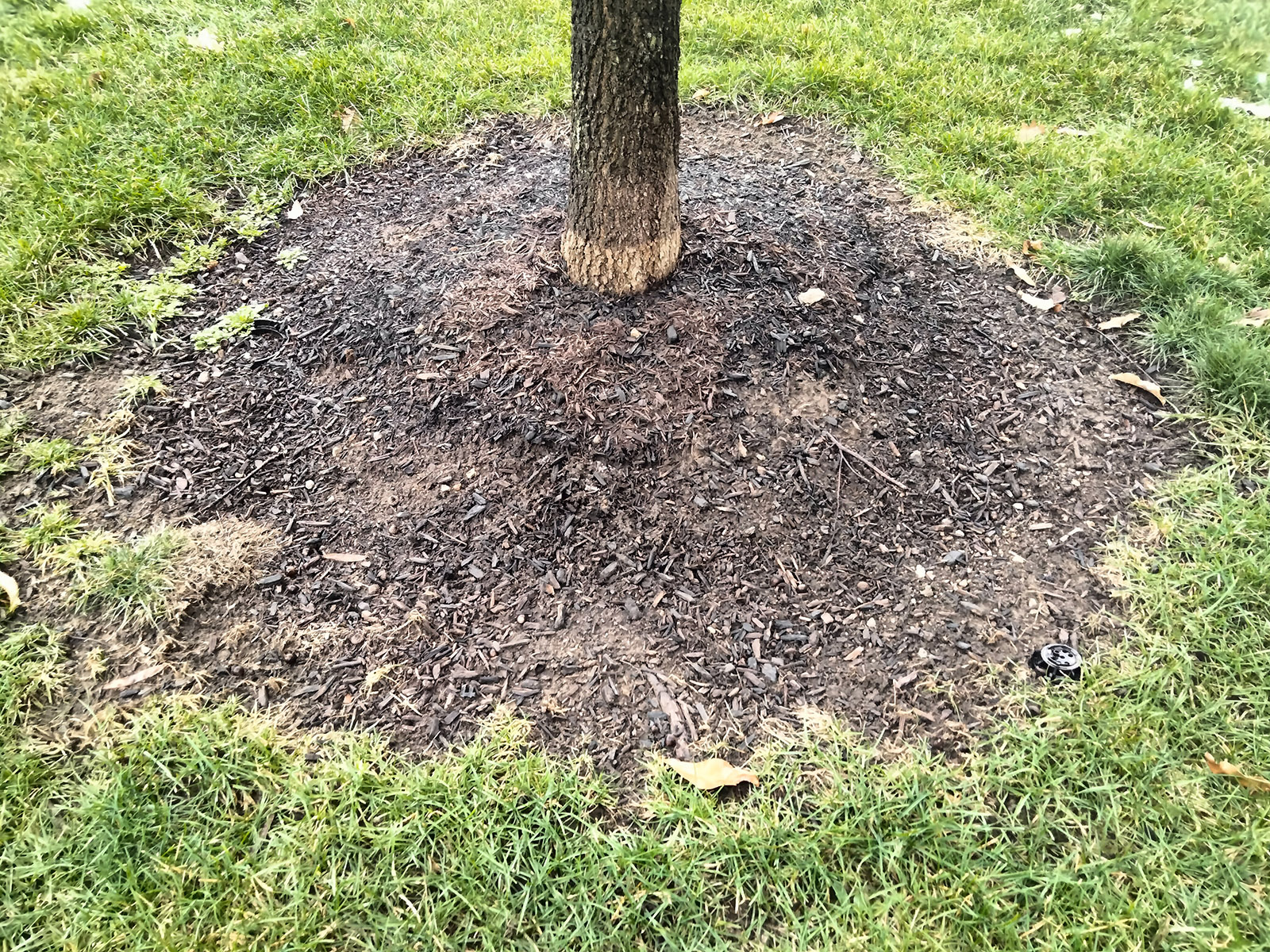
I returned the next day with several 25-pound bags of brown cypress (wood chip) mulch from our nearest home improvement store. After pulling up any existing bits of vegetation, I evenly spread a layer 3 inches deep. By the time I finished, it was all the way around the tree at a radius of 2 feet from the trunk. Ideally, it should reach the outer edge of the tree to protect and provide for the full length of the roots. However, that would’ve wiped out a major portion of grass in our narrow front yard, so I stopped far short of that mark.
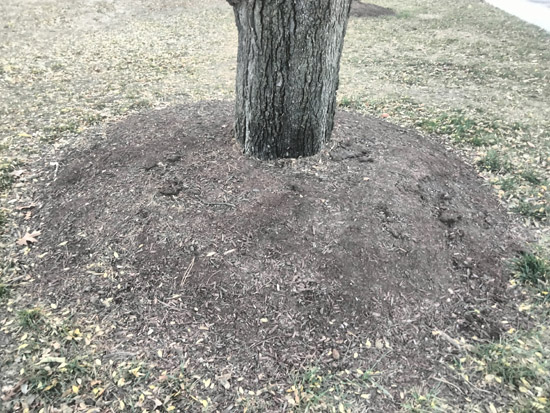
One thing I avoided was the creation of what’s known as a mulch volcano. This massive piling of mulch high onto the trunk of the tree not only looks ridiculous, but it’s also harmful to the tree and could potentially kill it. All mulch should be kept completely clear of the root flare (where the trunk meets the ground) by several inches. This is done to avoid an accumulation of moisture and possibly decay, which can cause the tree to be unstable and possibly knocked down by the wind.
Before long, we finished our new landscaping, and the “For Sale” sign finally went up. Everything looked beautiful, including the oak, but leaving the tree we loved was a little sad. Still, it was nice to know that, even as we were leaving to return to our roots, the organic mulch kept the tree well connected to its own.
Mark M. Hall lives with his wife, their three daughters, and numerous pets on a four-acre slice of paradise in rural Ohio. Mark is an experienced small-scale chicken farmer and an avid observer of nature. As a freelance writer, he endeavors to share his life experiences in a manner that is both informative and entertaining.
Originally published in the May/June 2025 issue of Countryside and Small Stock Journal and regularly vetted for accuracy.