A Unique Earthship Community
Eco-Friendly Housing
By Karin Deneke, Colorado
How would you like to own a home that harvests water from the sky, harnesses energy from wind and sun, can grow its own produce, utilizes a variety of recycled materials for its construction, and can function without utility bills?
“What is an Earthship?” was my question when decades ago, I first overheard the term during a discussion among a group of environmentalists.
I quickly learned that we are dealing with a functional home, a home that has a minimal impact on the environment, and is constructed with recycled materials such as tires, aluminum cans, glass bottles—and not to forget—the soil that surrounds it.
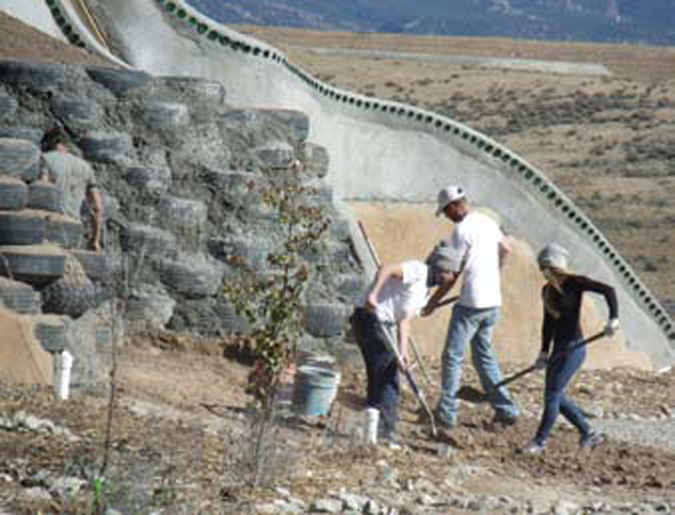
“If you can pound dirt, you can build an Earthship,” is a common phrase used in the Earthship community. And that is no joke. Old tires filled with sledge-hammered, rammed earth, stacked eight feet high, serve as load-bearing walls of these dwellings.
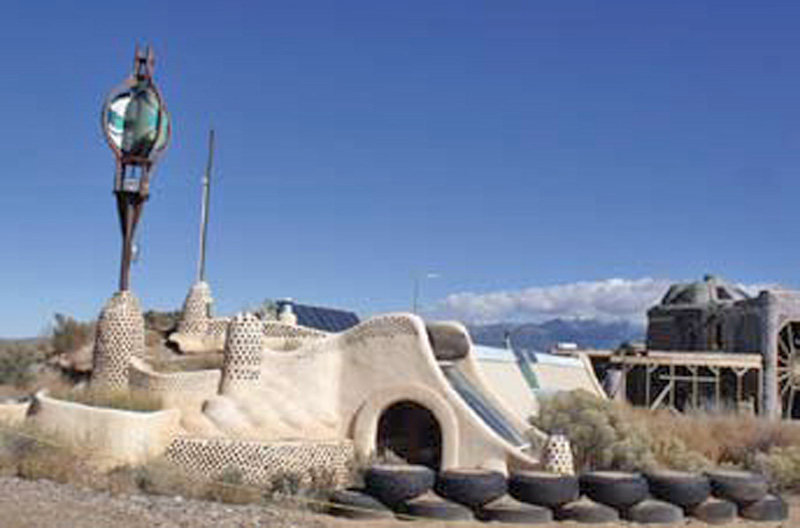
Recycled glass bottles imbedded into exterior mortar walls—admitting a play of beautiful light—complement the interior of the homes. Aluminum cans may be used in exterior walls for a special decorative look, and are inserted in interior walls, to help stretch the use of mortar/cement products that mold the walls.
Emphasis by far, is on a dwelling that is easy on the environment as it curtails carbon output, by recycling discarded materials, by taking advantage of free thermal heating and cooling, and using solar electric panels and vertical-axis windmills to meet the energy needs of the occupants. Earthships are designed for off-the-electric-grid living, using sun and wind, and geothermal heating and cooling.
And that is not all. Earthships catch their own roof water, recycle their gray water, and maintain their own sewage system. And they can grow food in their indoor gardens—a buffer zone for the house—by using the generated gray water. It is not uncommon to find banana and fig trees in addition to a variety of produce thriving inside these south-facing, glass-front dwellings. And all this can be accomplished pretty much without tapping into fossil fuels.
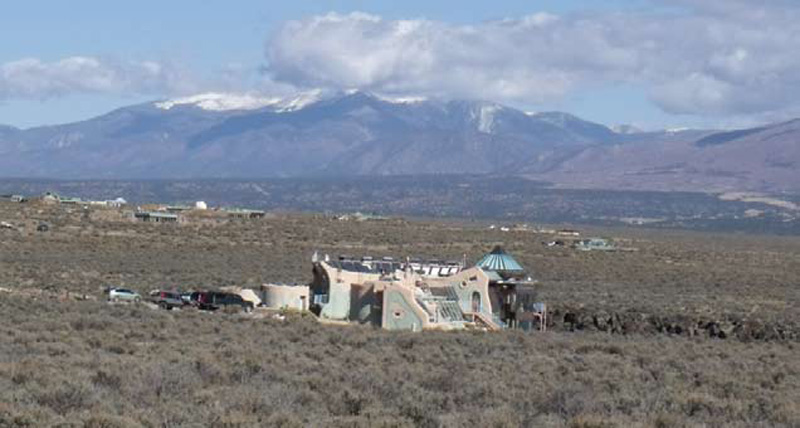
My first encounter with Earthships took place during a visit to northern New Mexico many years ago. For someone used to the traditional homes “back east,” it was quite an experience. From a distance, when traveling on Highway 64 from Tres Piedras, New Mexico, towards the Taos Valley, these free-form structures with their interesting profiles, reminded me of clusters of mushrooms pushing through the ground.
Over the years, and since I moved to south central Colorado, I continued to frequent this Earthship community which is located 12 miles northwest of Taos, New Mexico. The Greater Earthship Community, as it is officially called, occupies 600-plus acres of mesa. It is framed to the east by the majestic Sangre de Cristo Mountains. The homes are scattered thinly through a landscape of native shrubs—predominantly sagebrush. The main and only entrance is off Highway 64, appropriately named Earthship Way. Visitors have restricted access to the development, thus the privacy of the residents is protected.
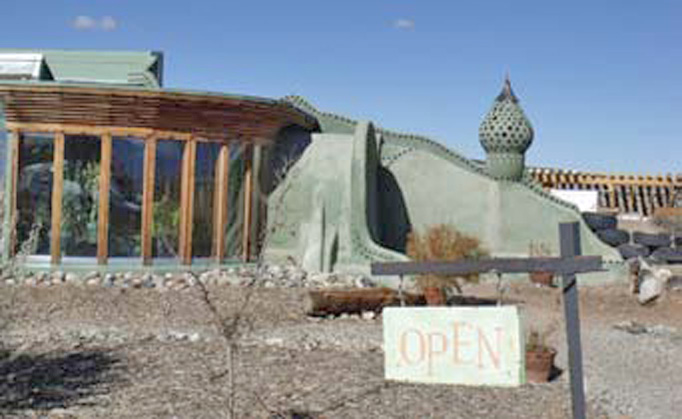
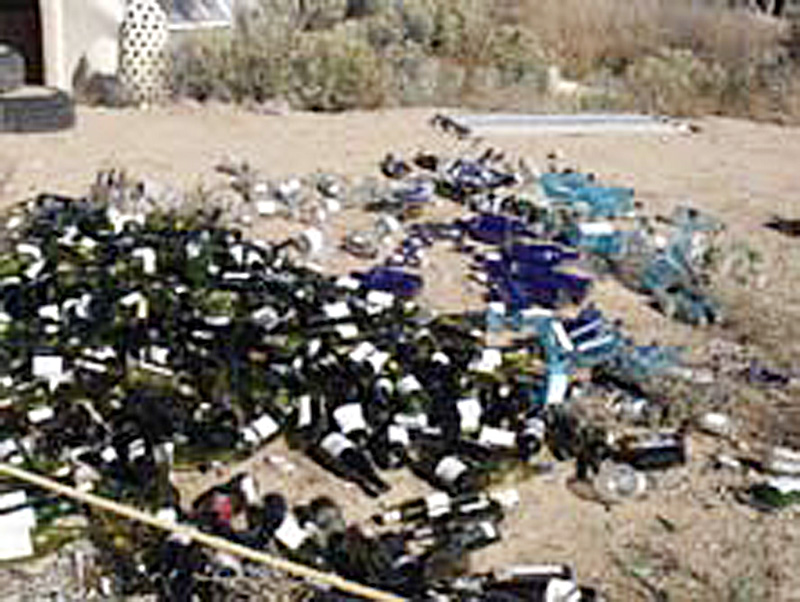
The community underwent a number of changes since I first discovered it. During a recent stop, I learned that the old visitor’s center at the right of the entrance as you are coming in, is now occupied by the new Academy, an instructional facility for Earthship builders. On the hill above it, in full view, old tires and heaps of colorful empty glass bottles lay scattered on the ground, obviously earmarked as future building materials.
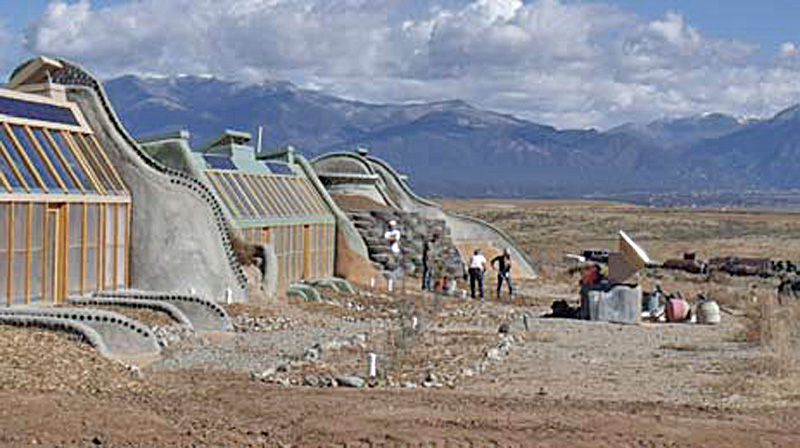
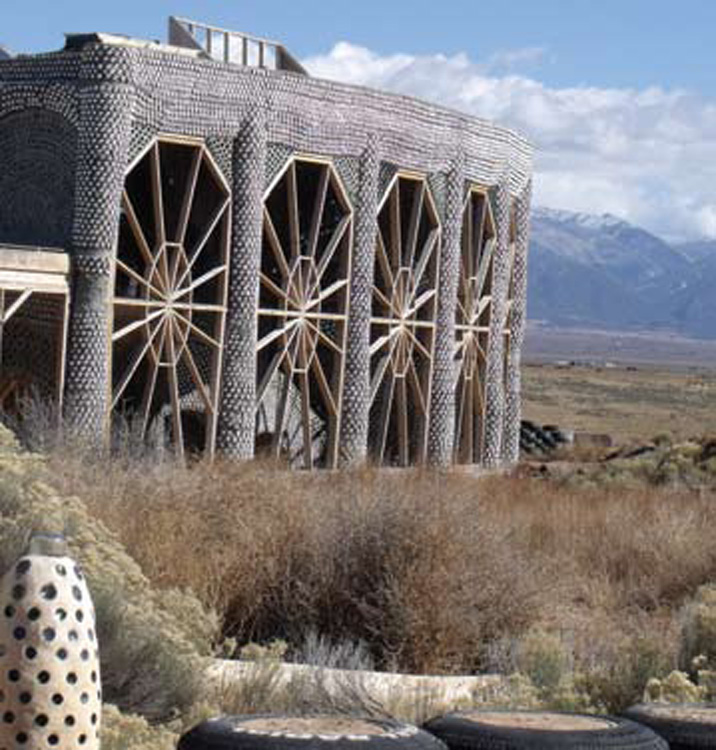
On its left, the old visitor’s center is now flanked by a multistory arched structure incorporating hundreds of shiny metal cans in its design. I was told this was an experimental building—a part of the Academy.
An older Earthship north of the entrance, sitting be-hind a partial privacy wall built with countless glass bot-tles, now serves as the new visitor’s center. A self-guided tour can be booked here for a mere $7 per person.
The Earthship Biotecture Academy has a formal admission process—and a student body hailing from various parts of the world. An experienced group of instructors cover classes from Earthship design to plumb-ing, gray water systems, and electrical power modules. All this takes place under the watchful eyes of the man who is the inventor of the Earthship concept, Michael Reynolds.
Reynolds, a 1969 graduate of the University of Cincinnati, introduced the Earthship in the 1970s. Those were the days of Pop Culture, as well as accelerated environmental awareness preceded by the celebration of the first Earth Day on April 22, 1970.
There are now several Earthship communities in the greater Taos area—one of these in the mountains. Well-know celebrities Dennis Weaver and Keith Carradine commissioned Reynolds to construct high-end Earth-ships for them. These homes received much attention. You can find Earthships in most western states as well as overseas. Reynolds’ journey has not always been an ideal one. He had to buckle under building code requirements for his expanding Earthship community, and eventually lost his license. Complaints over defects such as leaks and interior cracks in the plaster walls, in addition to lawsuits filed by unhappy buyers, caused the New Mexico Architects Board to strip him of his credentials, citing illegal and unsafe activities. Thus in the year 1998 The Greater Earthship Community was forced to become a UBC (Universal Building Code) enforced legal subdivision. Reynolds’ license was later reinstated.
Code enforcement also opened up financing for potential Earthship owners, who now have the opportunity to apply for mortgages from at least two Taos-based lenders. In addition, homeowners insurance is available for these dwellings.
The Earthship’s design evolved/improved over the years. Reynolds learned from his earlier mistakes. Earth-ship Biotecture, as Reynolds’ company is called, now serves as the contractor for all homes at the Greater Earth-ship Community. Construction drawings are available on the Biotecture website—the last time I checked, at the tune of $5,000 – $8,000 per plan, depending on the size of the home. In addition, for a lesser amount, a simple survival Earthship design is available. There are approximately 100 lots still for sale at the development. Lot sizes average from less than two, to three acres.
On the agenda by Earthship Biotecture for the Greater Earthship Community is the construction of a spec home. It will also substitute as a guesthouse, to give potential buyers a feel for Earthship living. I found the following quote from Michael Reynolds—testament of a man—some refer to as the “carbon zero architect.”
As a citizen of the earth
I fully have the right
To harvest water from the sky
To grow my own food in my own house
To harvest energy from the sun and wind
To contain and reuse my own water on my own land
To make my shelter comfortable without the use of fossil fuels
And to harvest what others throw away to construct my own home
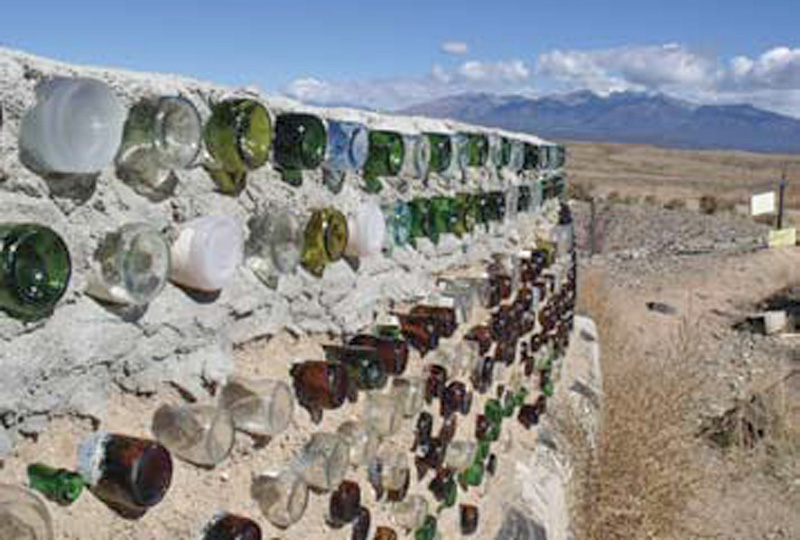
Thousands of glass bottles have been re-cycled to make light-filled walls while cans fill an arched structure.
Earthships do not fit well into the tight conventional stick-built neighborhoods surrounding our cities. And I am sure the building code for such subdivisions would frown upon them. Yet Earthships can be sited anywhere in the United States, providing they meet the UBC. Most Earthship construction takes place in the unspoiled land-scapes of the West—on the mesas and in the mountains. These structures make a positive statement and remind us that it is possible to create an energy efficient home that has minimal impact on the environment.